
Loading SaaS profile...
Loading SaaS profile...
A fully cloud-based business phone and contact center system designed for modern sales and support teams.
Provides instant provisioning of local and toll-free numbers in over 100 countries without requiring any physical hardware. Features advanced call routing, interactive voice response (IVR), and skill-based queueing for support teams. Integrates deeply with over 100 CRMs and helpdesks to automatically log calls, surface caller details, and trigger automations. Offers real-time analytics and live call monitoring to help managers track team performance and service levels. Enables seamless internal collaboration with call commenting, shared inboxes, and warm transfer capabilities.
It eliminates the need for expensive physical telephony infrastructure, operating entirely via a lightweight app and WebRTC. Deep, one-click integrations with tools like HubSpot and Salesforce prevent agents from having to switch contexts or manually log data. The intuitive interface allows non-technical managers to instantly configure call flows and IVR menus without IT support. Its highly scalable architecture allows fast-growing companies to add numbers and onboard new agents worldwide in minutes. Robust analytics dashboards provide immediate visibility into call volumes, wait times, and missed calls for data-driven staffing.
Category: Business & Operations
Team Size: 500-1000
Visit Website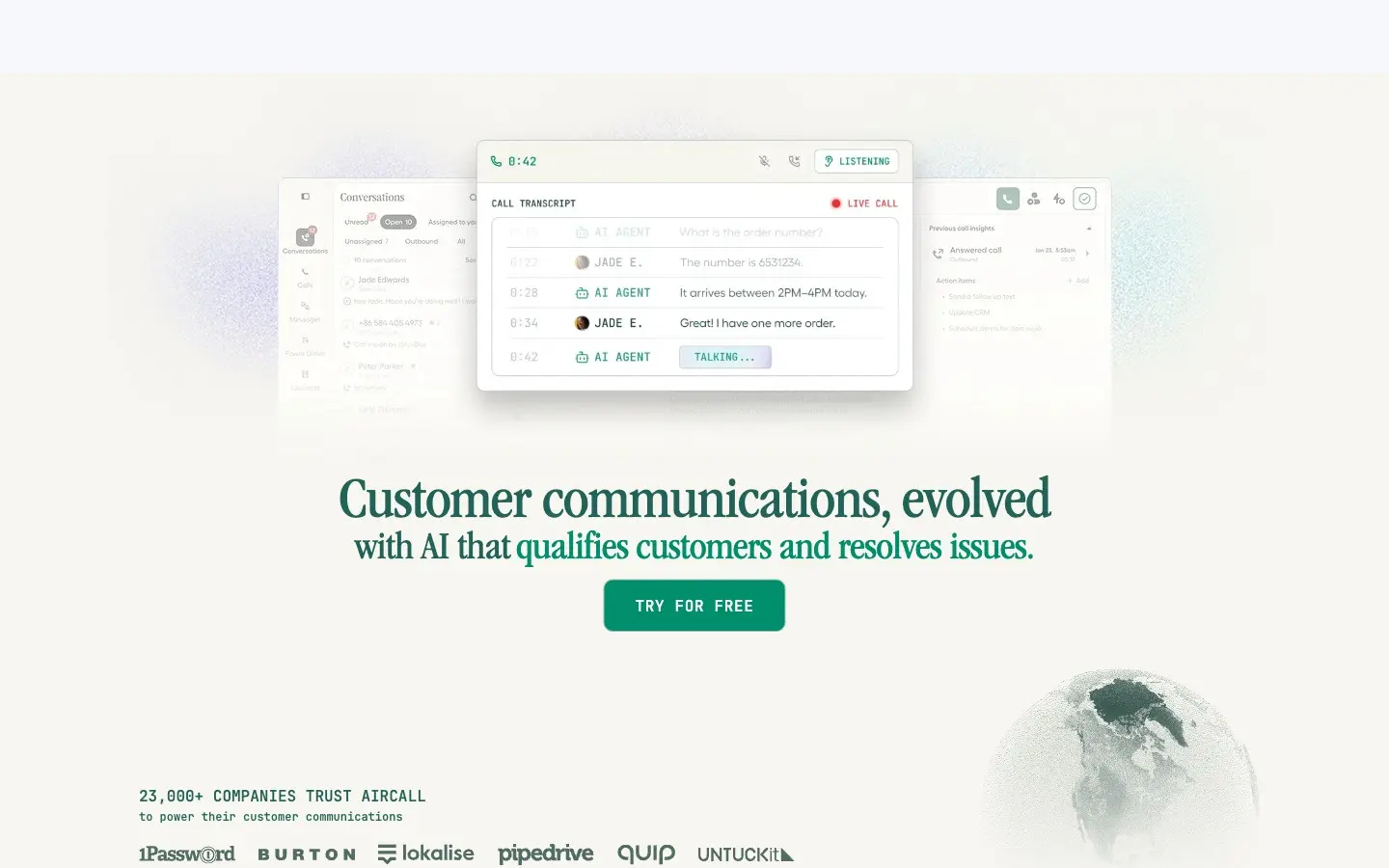
Aircall is a cloud-native voice platform that replaces traditional hardware desk phones with a powerful software application. Founded in Paris in 2014, it allows businesses to instantly set up international phone numbers, route calls, and manage complex call center operations remotely. By integrating deeply with popular CRMs and helpdesk tools like HubSpot, Salesforce, and Zendesk, Aircall automates data entry and empowers sales and support teams to handle voice interactions directly within their existing workflows.
Aircall was founded in Paris in 2014 by Olivier Pailhès, Jonathan Anguelov, Pierre-Baptiste Béchu, and Xavier Durand. Working out of the eFounders startup studio, they realized that setting up business telephony was incredibly tedious, hardware-dependent, and disconnected from modern software. After joining the 500 Startups accelerator in San Francisco in 2015, they shifted focus to building a completely cloud-based API-driven phone system. Aircall grew rapidly alongside the rise of SaaS CRMs, eventually reaching a $1 billion valuation in 2021 and surpassing $175 million in annual recurring revenue by 2025.