
Loading SaaS profile...
Loading SaaS profile...
Cache-aware LLM routing engine treating inference providers as trading venues.
Exposes a unified OpenAI-compatible endpoint that routes prompts across 12+ major LLM inference providers dynamically. Evaluates real-time token pricing, prompt cache hit probabilities, and latency spreads to lower inference costs. Executes automatic failover and redundancy chains across fallback providers when error rates or latency spike. Enforces declarative policy constraints like minimum throughput (TPS), data residency regions, and budget caps per workspace.
Factoring in prompt cache-state efficiency and real-time provider pricing captures spreads that static gateways miss. Unified OpenAI-compatible API format enables 10-minute drop-in deployment without rewriting existing client codebases. Zero Data Retention (ZDR) architecture ensures prompt content and sensitive data are never stored or logged on central servers. Automated multi-provider failover chains eliminate single-point downtime risks during vendor outages or rate limits.
Category: AI & Automation
Team Size: 2-10
Visit Website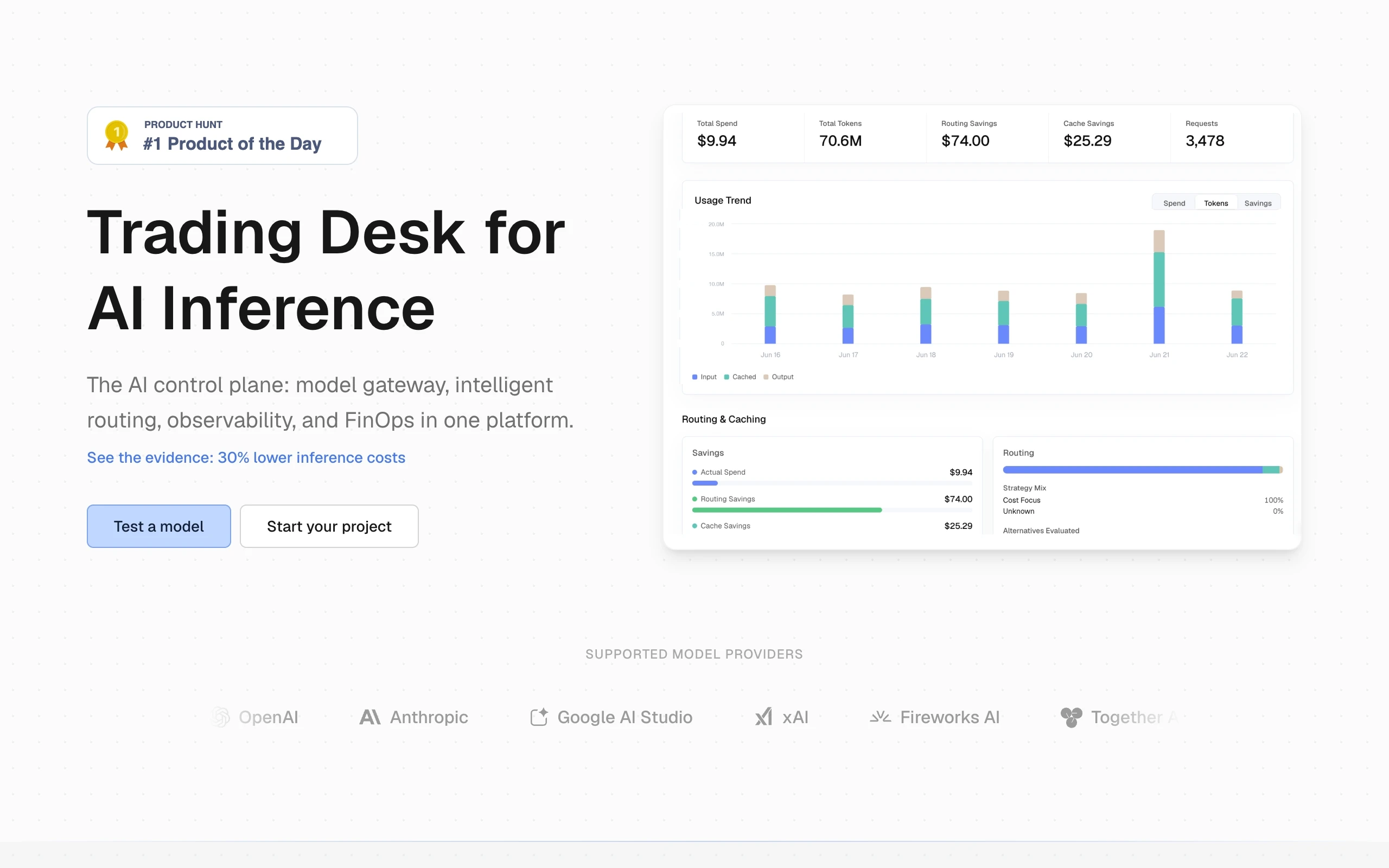
Auriko is a cache-aware LLM routing platform and model gateway built to optimize AI inference costs. Built by former quantitative traders, Auriko treats inference providers like financial trading venues by arbitraging pricing spreads and cache-hit probabilities in real time. It exposes a unified OpenAI-compatible API across over a dozen inference providers. Auriko transparently routes each request based on token pricing, cache state, latency, and reliability without storing prompt data.
Auriko was created in 2026 by ex-quant options traders who transitioned into building AI agents. Driven by a trader's obsession with finding market pricing inefficiencies, the founders realized LLM costs were heavily influenced by prompt caching mechanics and real-time vendor price spreads. They built Auriko to bring quantitative arbitrage and algorithmic routing to LLM inference.