
Loading SaaS profile...
Loading SaaS profile...
A no-code platform that allows users to quickly build and customize AI-powered assistants using GPT technology connected to their own business data.
Allows users to build custom AI assistants connected directly to their own business data and documents. Supports direct file uploads, database connections, and integrations with spreadsheets to train the chatbot. Provides an interactive training feature where the AI asks questions to learn the necessary information. Offers multi-channel access through a chat webpage, desktop application, external integrations, and an API. Enables granular data access control, allowing users to create separate, specialized assistants for different teams or use cases.
It eliminates the need for coding, allowing anyone to build a custom GPT-powered chatbot in just a few minutes. Integrating directly with specific business data ensures the AI gives accurate, context-aware answers rather than generic responses. The flexibility to deploy the assistant on multiple platforms (such as Slack and Zapier) ensures it fits naturally into existing daily workflows. Granular permission controls mean users can safely compartmentalize sensitive data by department (e.g., HR vs. Marketing). Continuous learning capabilities allow the assistant to improve its accuracy and efficiency over time as it interacts with users.
Category: Productivity
Team Size: 1-10
Visit Website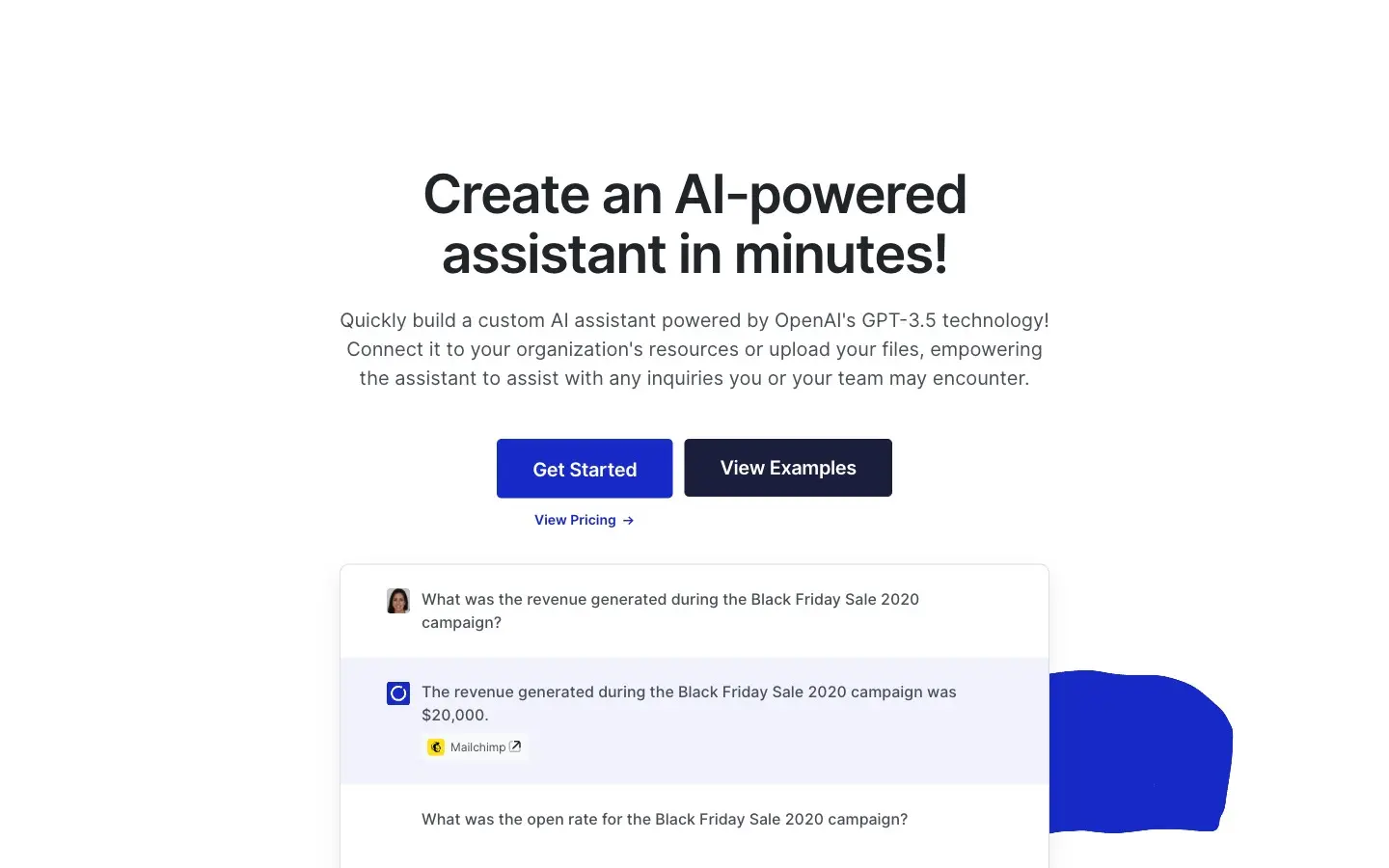
Emma AI is a platform designed to help users quickly create custom AI assistants and help-desk chatbots without requiring any coding knowledge. Powered by OpenAI's GPT models, it allows users to connect their own data sources, upload files, and link spreadsheets so the assistant can answer specific organizational inquiries accurately. Emma AI can integrate seamlessly into existing workflows through platforms like Slack, Zapier, and its own API, making it an ideal tool for teams seeking to automate customer support or streamline internal knowledge retrieval.
Emma AI was developed to democratize access to advanced generative AI (like GPT-3.5 and GPT-4) for non-technical users and small businesses. The platform was built to solve the universal problem of time wasted searching for internal documents or answering repetitive team questions by enabling anyone to create personalized, easily deployable AI assistants for specific workflows.