
Loading SaaS profile...
Loading SaaS profile...
API integration testing platform that captures edge cases and failure modes.
Provides runnable API sandboxes for 60+ popular services to test webhooks, retries, and async state changes. Connects natively via Model Context Protocol (MCP) to AI coding assistants like Cursor and Claude Code. Builds a memory graph capturing API failure modes, timing drift, and observed schema changes across runs. Converts OpenAPI specs into stateful sandboxes with pre-configured seed data and failure scenarios.
Integrates via MCP directly inside IDEs, eliminating context switching to external dashboards during active development. Maintains a global memory graph of known API failure patterns to surface edge cases without rediscovery. Simulates asynchronous event sequences and duplicate webhooks rather than returning simple static success responses. Prevents API quota depletion and rate limiting during heavy automated AI coding sessions.
Category: Utilities & System Tools
Team Size: 2-10
Visit Website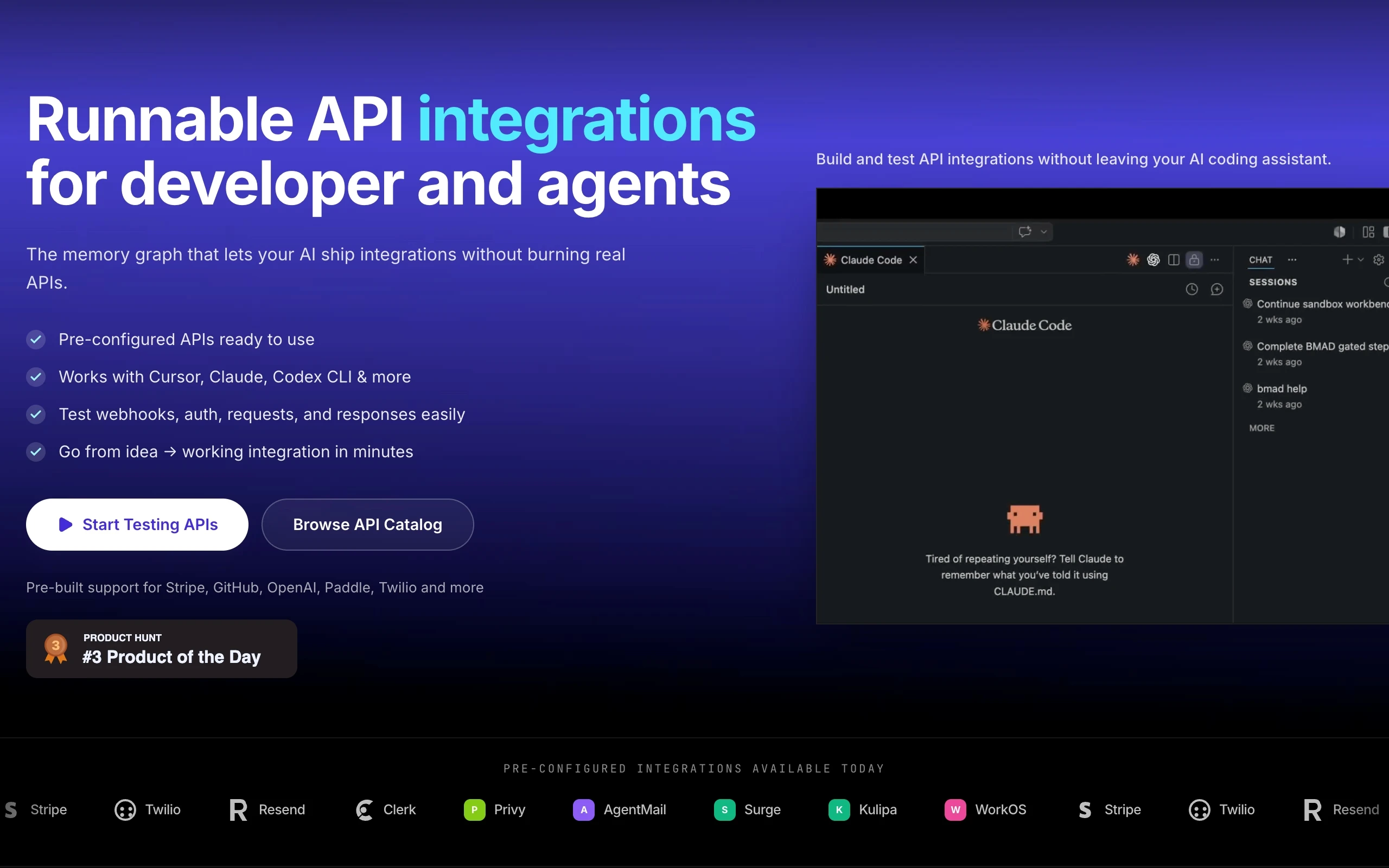
FetchSandbox is an API integration testing platform and memory graph designed for developers and AI agents. It provides runnable sandboxes for over 60 popular APIs to simulate webhooks, retries, state changes, and out-of-order event flows without consuming live API quotas. By connecting natively via Model Context Protocol (MCP) to AI coding tools like Cursor and Claude Code, FetchSandbox helps teams verify complex integration behaviors before deploying to production.
FetchSandbox was created in 2026 by Raj Nagulapalle and Ajit Gupta in San Jose, California. Having spent years building API integrations at companies like PayPal, the founders realized that writing integrations was straightforward, but predicting edge cases like duplicate webhooks and late events was difficult. They created FetchSandbox to give developers and AI agents stateful sandboxes that remember failure behaviors.