
Loading SaaS profile...
Loading SaaS profile...
Cloud-native, open-source workflow orchestrator for data and ML pipelines.
Orchestrates complex data and machine learning workflows. Ensures reproducibility through strongly typed interfaces and version control. Automates distributed execution across cloud and GPU resources. Provides built-in data lineage, observability, and logging. Enables parallel processing and dynamic DAG (Directed Acyclic Graph) creation.
Reproducibility: Every task and workflow is versioned, allowing for easy rollbacks and identical reruns. Scalability: Built natively for Kubernetes, it can handle thousands of parallel tasks for massive hyperparameter tuning. Resilience: Offers one-click recovery from failed tasks without rerunning successful ones. Extensibility: Supports Python, Java, Scala, and JS, fitting into almost any existing tech stack.
Category: Utilities & System Tools
Team Size: 26-100
Visit Website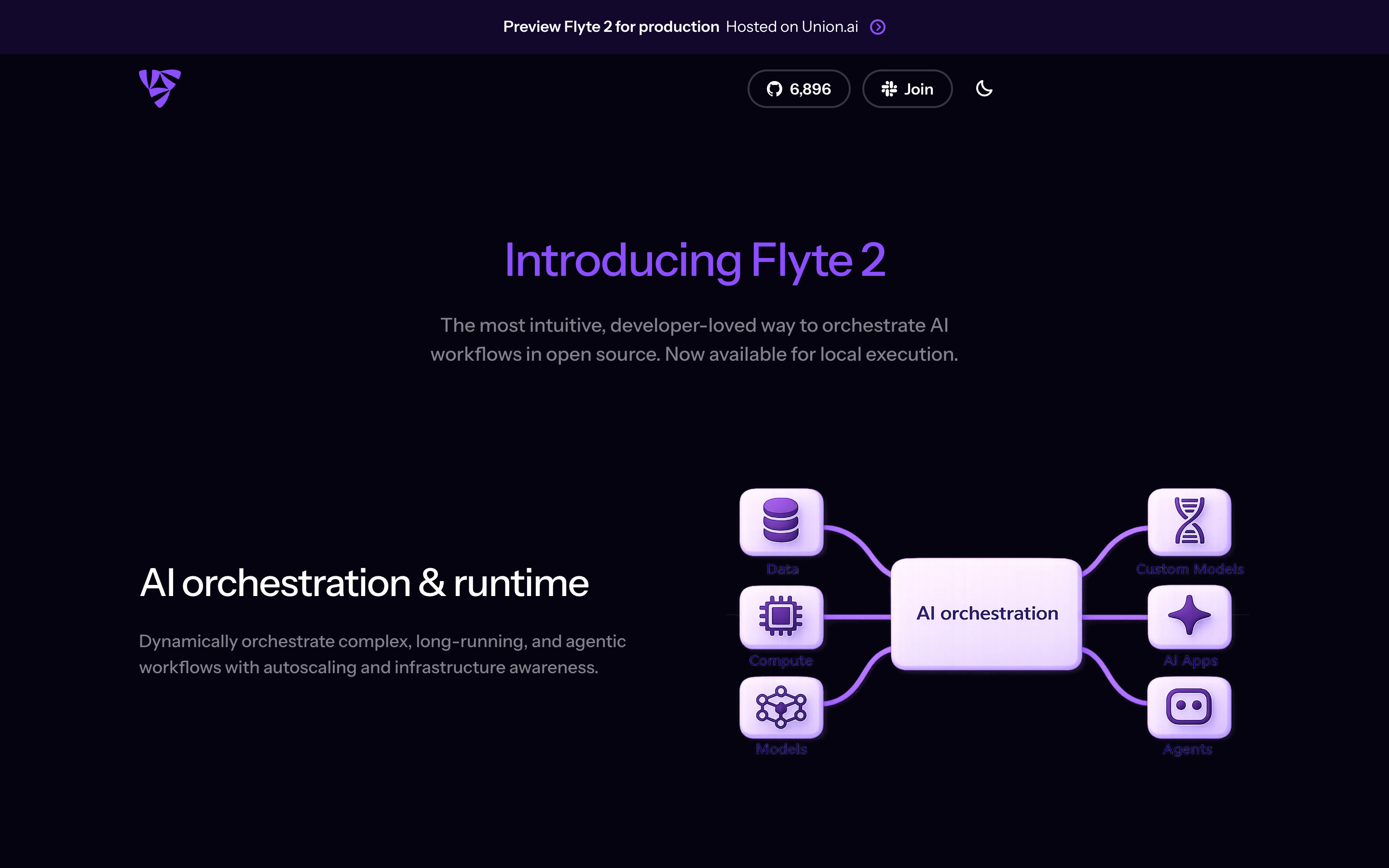
Flyte is an open-source workflow automation platform designed to simplify the development and management of complex data and machine learning (ML) pipelines. Originally developed by Lyft, it provides a strongly typed framework for building reproducible and scalable workflows that can run across CPUs, GPUs, and multiple cloud environments using Kubernetes.
Flyte was created at Lyft to manage their massive scale of data and ML projects. In 2020, Lyft open-sourced the project and it was subsequently adopted by the Linux Foundation. Key engineers from the original project, including Ketan Umare, went on to found Union.ai to provide professional support and hosting for the platform.