
Loading SaaS profile...
Loading SaaS profile...
Open-source library for building machine learning web interfaces.
Converts raw Python functions into interactive web applications without requiring HTML, CSS, or JavaScript knowledge. Provides a comprehensive suite of UI components including textboxes, chatbots, image processors, and file uploaders for model interaction. Enables rapid prototyping by allowing developers to demo models, share them via public URLs, and collect user feedback efficiently. Integrates natively with the Hugging Face model ecosystem, facilitating seamless hosting and deployment of AI demos in Spaces. Handles complex backend logic including API routing, event listeners, and data state management through a simplified Python-based syntax.
Simple Python-first approach allows developers to build functional interfaces in minutes without needing dedicated frontend resources or expertise. Deep integration with Hugging Face provides an immediate distribution channel for demos, driving massive adoption within the machine learning community. Highly flexible component architecture supports everything from simple text-in/text-out functions to complex, multimodal chat interfaces with state management. Open-source nature and active community support ensure rapid feature evolution and compatibility with the latest AI tools and research developments. Standardized UI generation provides a consistent and professional look for demos, allowing stakeholders to easily interact with and evaluate models.
Category: AI & Automation
Team Size: 11-25
Visit Website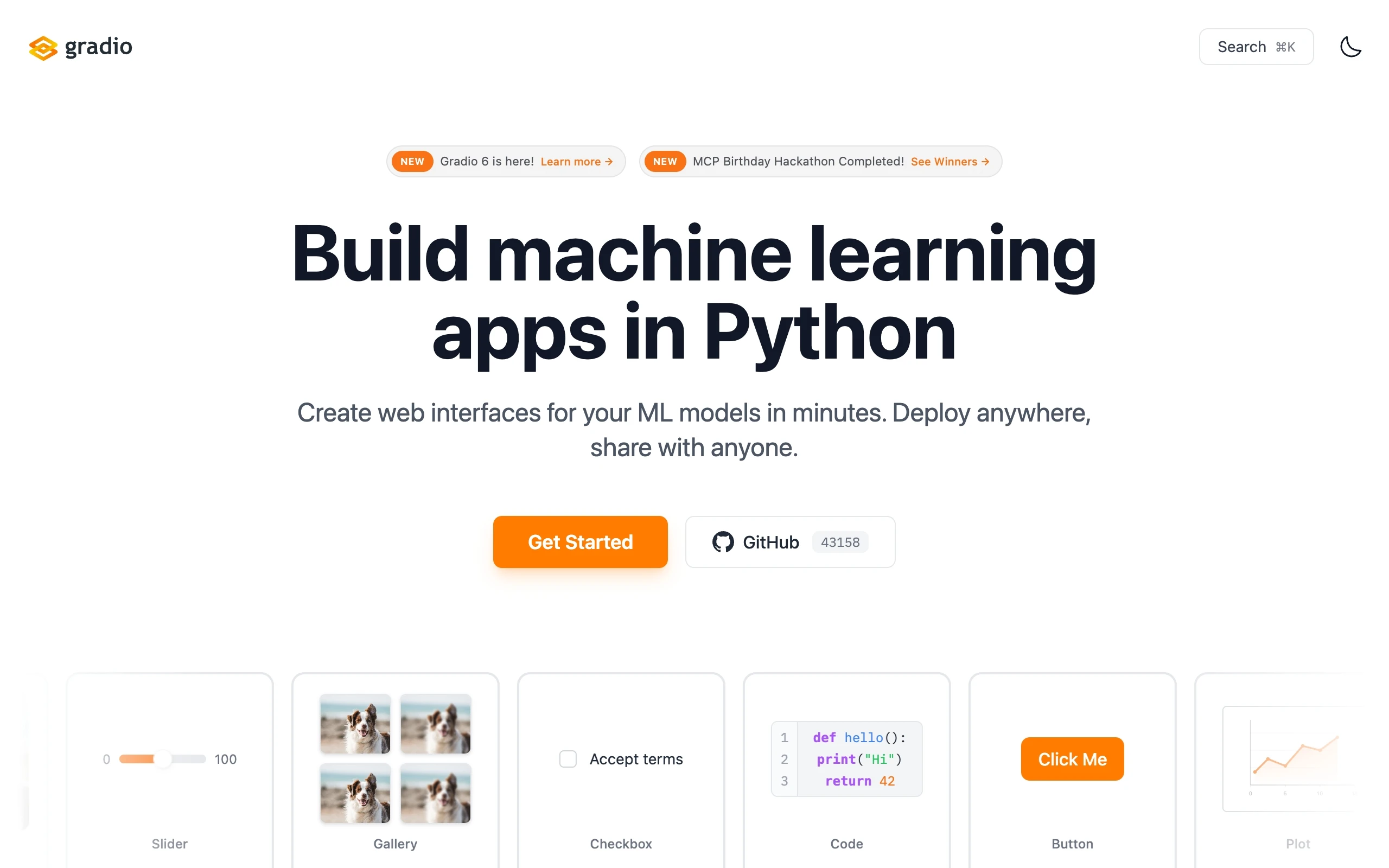
Gradio is an open-source Python library that allows developers to quickly create interactive, shareable web interfaces for machine learning models, APIs, and Python functions. It eliminates the need for frontend development knowledge by automatically generating UI components based on input and output parameters. Widely used for prototyping and demos, it is natively integrated into the Hugging Face ecosystem.
Gradio was founded in 2019 by Abubakar Abid, Dawood Khan, and Ali Abdalla with the goal of making machine learning models accessible to everyone. The tool gained rapid traction for its simplicity in building interfaces. In December 2021, the project and team were acquired by Hugging Face to further accelerate its development and ecosystem integration.