
Loading SaaS profile...
Loading SaaS profile...
An enterprise IT financial management platform that enables organizations to visualize, analyze, and optimize IT spend through automated cost transparency.
CIOs IT Financial Managers Finance Directors Infrastructure Managers Digital Transformation Leaders
Automated data reconciliation reduces the manual labor of mapping financial data to IT service catalogs Visual cost models provide an intuitive bridge between complex technical infrastructure and simple business services Scenario modeling and 'what-if' analysis allow for faster, more accurate IT budgeting and forecasting Transparent cost allocation methods simplify internal chargebacks and showback processes for business units Dynamic reporting suites highlight cost inefficiencies, helping teams identify opportunities for infrastructure optimization
Category: Business & Operations
Team Size: 26-100
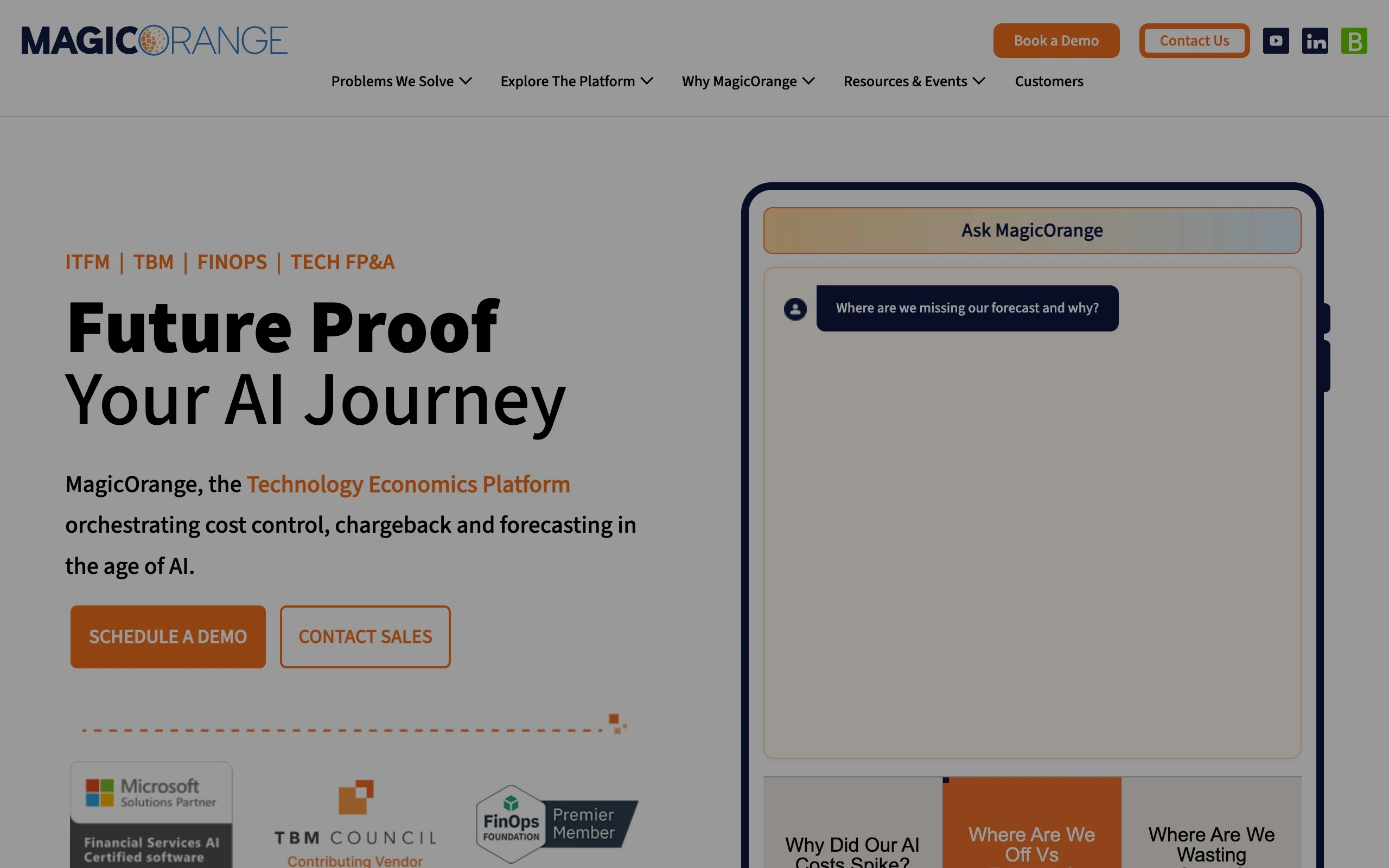
Magic Orange is a sophisticated IT Financial Management (ITFM) and Technology Business Management (TBM) platform designed to solve the complexity of enterprise IT budgeting and cost allocation. It automates the ingestion, normalization, and categorization of data from disparate financial and operational sources into a unified, transparent view of IT costs. By mapping infrastructure, applications, and services to business value, Magic Orange enables CIOs and IT leaders to make data-driven investment decisions. The platform empowers organizations to shift from viewing IT as a cost center to a strategic business partner, ensuring alignment between technology spending and corporate goals.
Magic Orange was founded in 2012 by IT finance experts and strategists based in South Africa, with global headquarters in Johannesburg and operations in Europe and the US. The founders identified that most CIOs lacked the visibility to explain the true business value of their multi-million dollar technology spends, leading to fragmented communication with the C-suite. They built Magic Orange to be a transparent, automated lens through which enterprise leadership could rationalize and optimize IT investments.