Loading SaaS profile...
Loading SaaS profile...
Active learning tool using adaptive questioning to test understanding.
Generates adaptive questions from notes, web URLs, and GitHub repositories to test subject comprehension. Evaluates user explanations using the Feynman method to highlight gaps in technical understanding. Resurfaces learned concepts at optimal review intervals to promote long-term memory retention. Visualizes interconnected knowledge graphs to track mastery across complex, multi-topic subjects.
Feynman method integration ensures true concept comprehension rather than passive superficial reading. Adaptive questioning targets specific user confusion points rather than repeating known facts. Spaced repetition scheduling resurfaces material at optimal retention intervals. Direct source intake from URLs and GitHub repositories allows instant learning roadmap creation.
Category: Education & Learning
Team Size: 1
Visit Website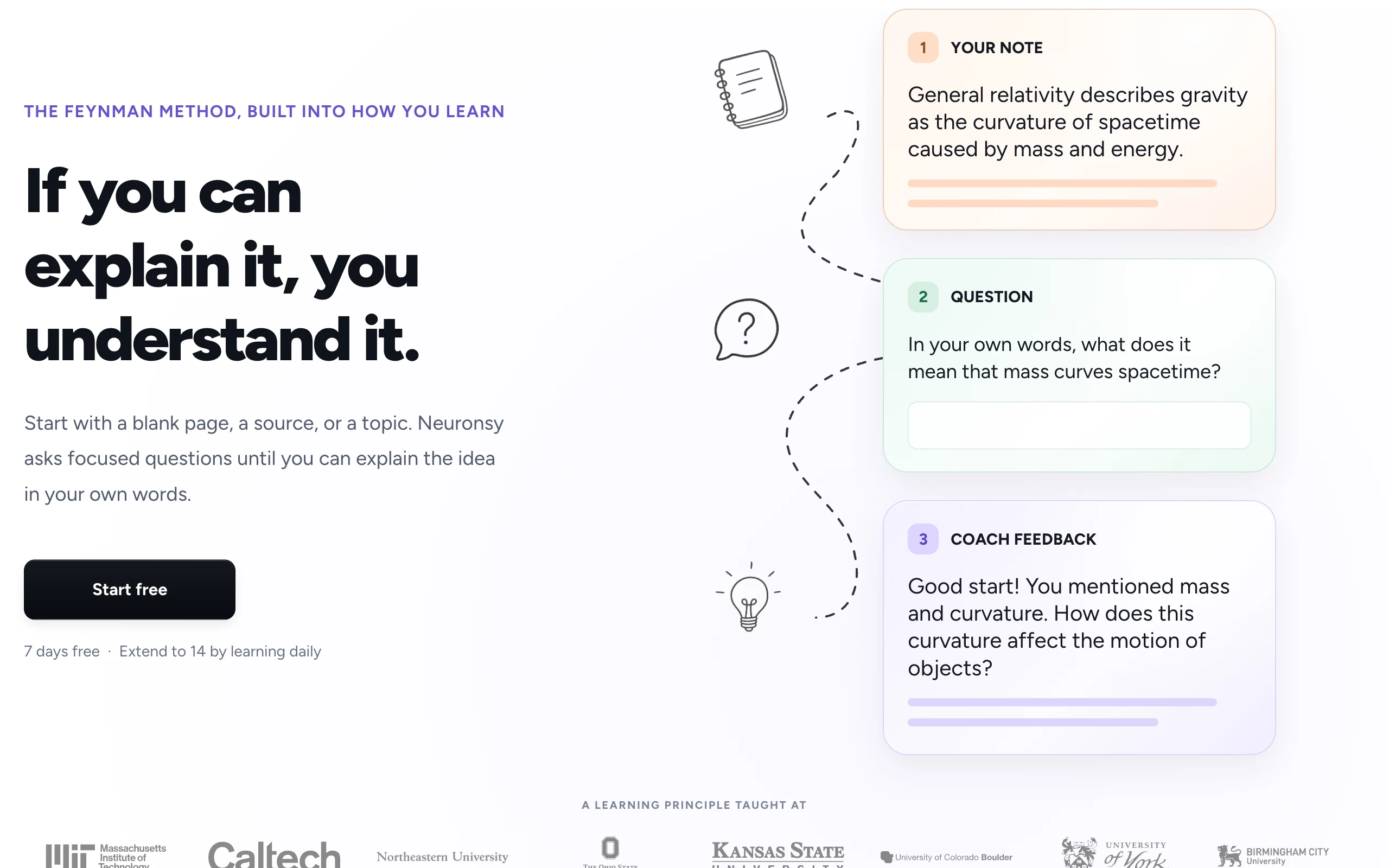
Neuronsy is an AI-powered active learning platform built on the Feynman method to help students, developers, and self-learners master complex technical subjects. Instead of passive reading or flashcard memorization, Neuronsy challenges users with adaptive questioning based on uploaded notes, URLs, GitHub repositories, or custom topics. The platform tests whether learners can explain concepts in their own words, identifies comprehension gaps, and resurfaces concepts at optimal intervals to maximize long-term retention.
Neuronsy was created in 2026 by developer Graniet in France. Built to solve the problem of passive learning where students read complex documentation without truly retaining the material, Graniet designed Neuronsy around the Feynman technique. The platform forces learners to explain technical concepts in their own words, using AI to pinpoint knowledge gaps.