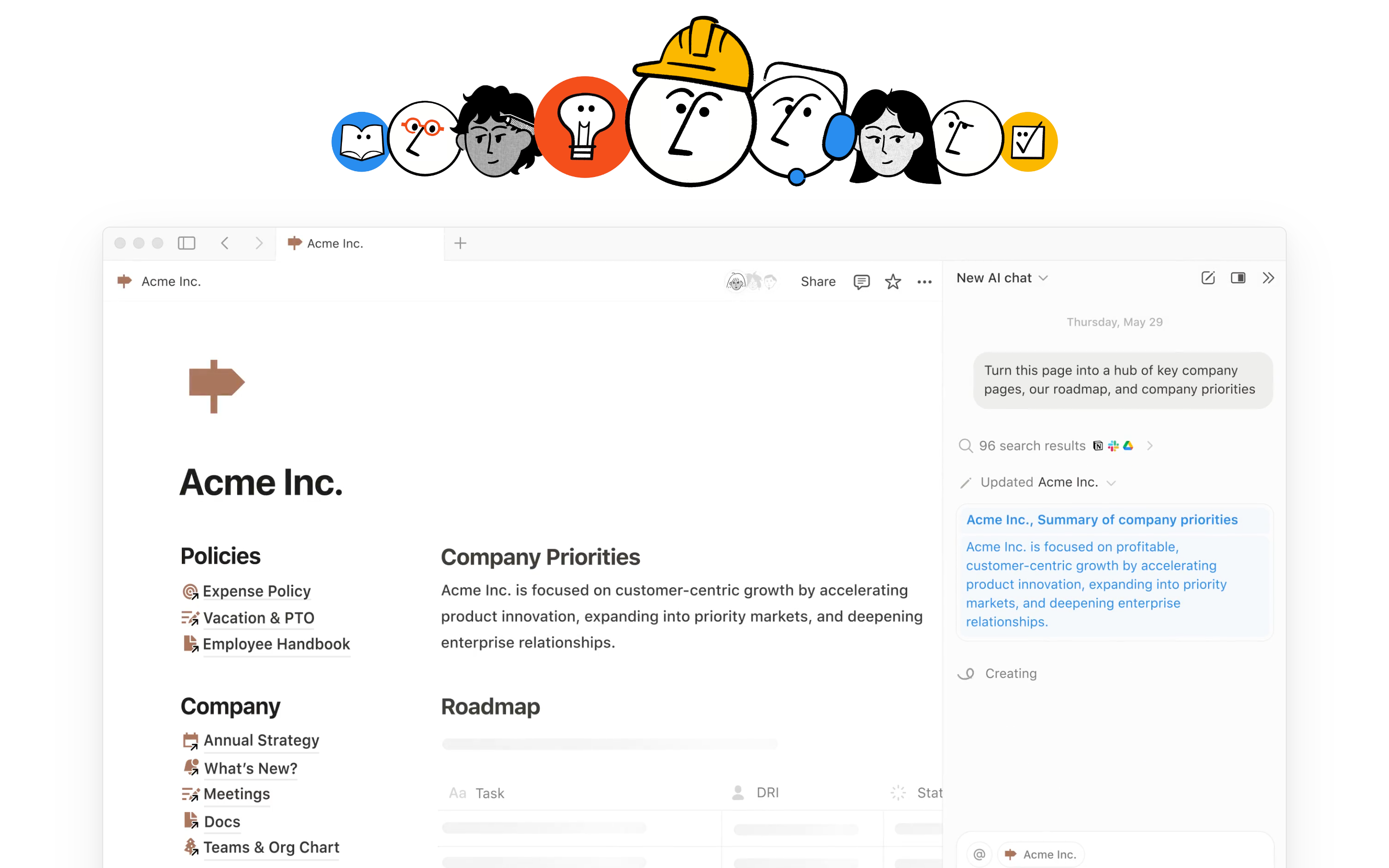
It kills the "too many tabs" problem. Instead of opening Asana for tasks, Notion puts them all in one interface. You can type a document, and turn that database into a Kanban board instantly.
Why it works
It removes context switching. When your task list lives right next to the design spec and the meeting notes, you flow faster. It also democratizes tool-building—a non-technical marketing manager can build a custom workflow without asking engineering for help.
Notion is the "Lego set" for your business. It combines your Google Docs, Trello boards, and Excel sheets into one programmable workspace. You build the workflow you need, rather than forcing your team into rigid tools.
Founded year:2013
Founder:Ivan Zhao, Akshay Kothari
Team size:1,920
HQ:San Francisco, United States
Status:Active
Funding status:Funded
Customer type:B2B2C
Funding:$343M
Pricing:Freemium
Platform:Web • iOS • Android • Windows • macOS
Integrations:Slack, Google Drive, Zapier
What it does
It kills the "too many tabs" problem. Instead of opening Asana for tasks, Notion puts them all in one interface. You can type a document, and turn that database into a Kanban board instantly.
Who it's for
Indie founders
Startups
Students
Professionals.Freelancers
Productivity Enthusiasts
Why it works
It removes context switching. When your task list lives right next to the design spec and the meeting notes, you flow faster. It also democratizes tool-building—a non-technical marketing manager can build a custom workflow without asking engineering for help.
Alternatives
Comparison overview
Notion is the middle ground between structure and chaos. Evernote is a digital filing cabinet (static), while Airtable is a database (rigid). Notion sits in the middle: it's a document that acts like a database. If you want a "second brain" that can also manage your team's sprint, Notion is the winner.