
Loading SaaS profile...
Loading SaaS profile...
WebOps and web hosting control panel for server management.
Provides a centralized web dashboard to configure web servers, database instances, DNS, and email services. Automates WordPress site creation, plugin updates, security hardening, and staging via the native WordPress Toolkit. Manages server-level security with SSL/TLS certificate automation, firewall rules, and malware scanning extensions. Supports multi-tenant web hosting environments by enabling customer billing and reseller account partitioning.
Cross-platform support natively runs on both Linux and Windows Server operating systems. Modular extensions library allows admins to plug in security, monitoring, and cloud backup tools. Integration with hyperscalers like AWS, Google Cloud, Azure, and DigitalOcean simplifies server provisioning. Role-based access management enables safe delegation between server admins, resellers, and web clients.
Category: Utilities & System Tools
Team Size: 100+
Visit Website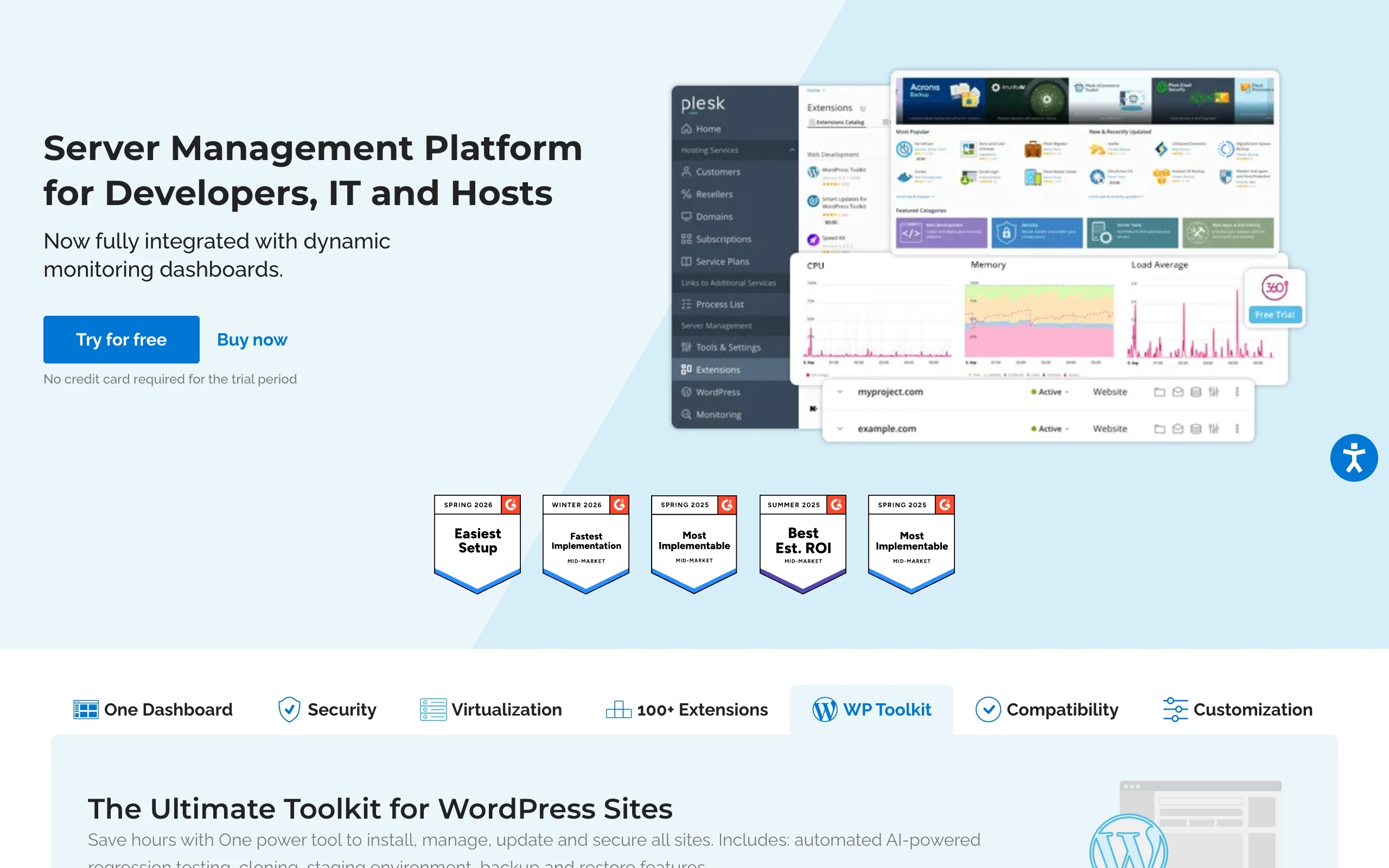
Plesk is a leading web hosting control panel and server management platform designed for WebOps professionals, sysadmins, digital agencies, and hosting providers. It provides a graphical interface to manage web servers, automate application deployments, configure DNS settings, and monitor security. Equipped with native tools like the WordPress Toolkit, integrated backup systems, and one-click SSL provisioning, Plesk operates across both Linux and Windows operating systems. It is part of the WebPros family of hosting tools.
Plesk was created in 2000 in Novosibirsk, Russia, by Dimitri Simonenko and launched commercially in 2001. Developed to simplify complex Linux server command-line management for non-technical users, Plesk quickly grew into an industry standard. Following acquisitions by SWSoft, Parallels, and Oakley Capital, Plesk became a core entity under WebPros, operating globally.