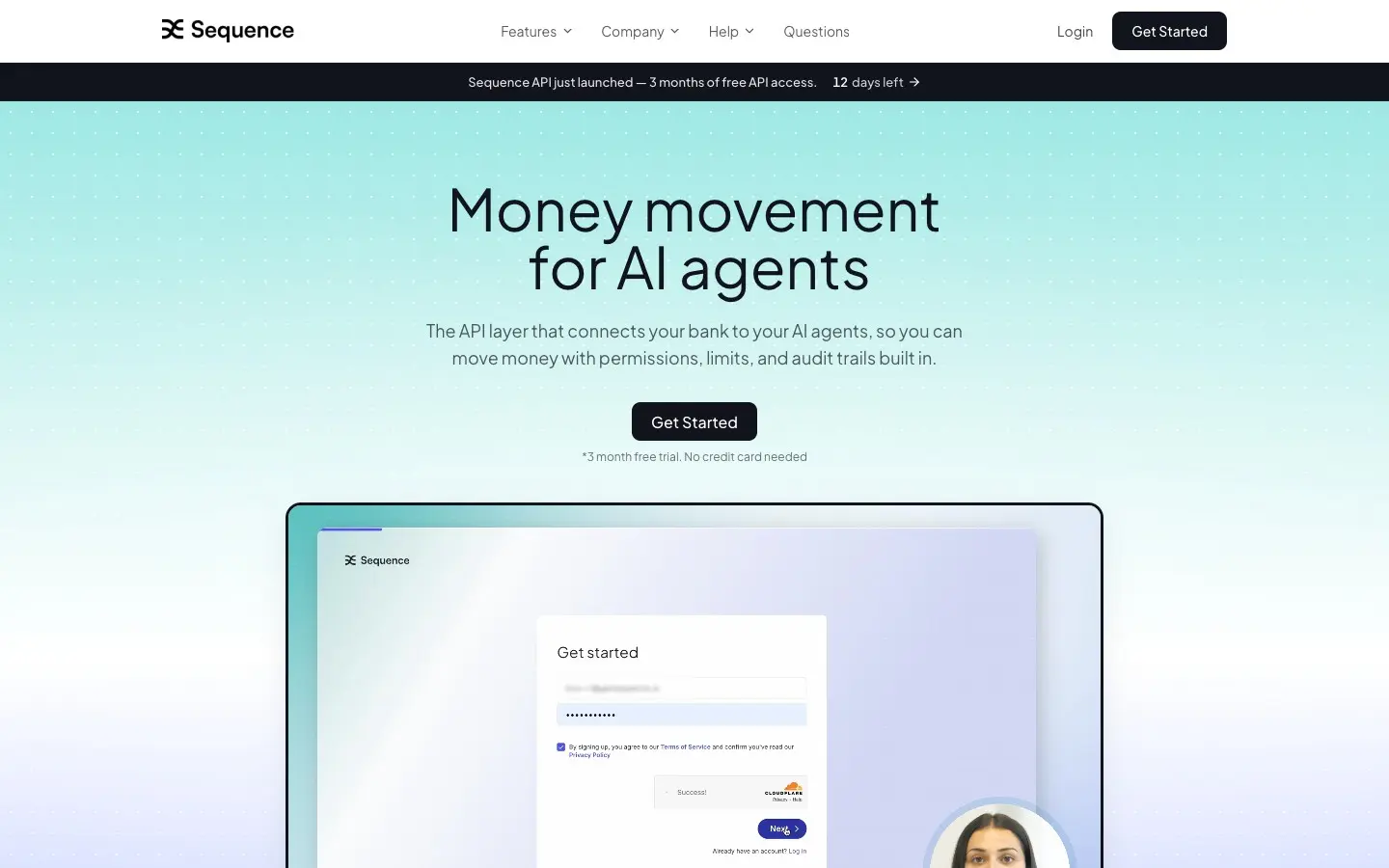
Financial execution layer enabling AI agents to route real money safely.
What it does
Exposes API and MCP endpoints for AI agents to trigger asynchronous real money transfers.
Enforces server-side spending limits and account allowlists independently of LLM system prompts.
Logs all agentic financial transactions to an immutable audit trail separate from chat history.
Supports deterministic if-then transfer rules that execute automatically upon agent request.
Why it works
Server-side spending guardrails prevent prompt injection attacks or hallucinations from overdrawing accounts.
Unified API abstracts multi-account banking infrastructure, virtual debit cards, and sub-accounts into simple endpoints.
Native MCP connector allows zero-code financial execution setup in tools like Claude Desktop and Cursor.
Asynchronous transaction tracking with idempotency tokens prevents duplicate payment transfers on retries.
Financial execution layer enabling AI agents to route real money safely.
Overview
Sequence Agentic is a financial execution layer that allows autonomous AI agents to send, split, and route real money across bank accounts, credit cards, and loan products. Connected via a single API or Model Context Protocol (MCP) server, it bridges conversational LLMs and automated workflows directly to banking rails. To prevent AI hallucinations or prompt injection exploits from draining funds, Sequence enforces server-side spending limits, account allowlists, deterministic rules, and immutable audit logs outside the model's context window.
Founded year:2024
Founder:Shirat Zmora
Team size:2-10
Popularity:Processes over $3 billion in money routing volume across 300,000+ monthly money movements.
HQ:New York, New York, United States
Status:Active
Funding status:Bootstrapped
Customer type:B2B
Funding:Bootstrapped
Pricing:Freemium
Tech stack:Node.js, TypeScript, Model Context Protocol (MCP), REST API, Plaid API, Thread Bank Banking Rails
Platform:Web
Integrations:Claude, Cursor, n8n, Zapier, Model Context Protocol (MCP), Plaid, Thread Bank, Stripe
What it does
Exposes API and MCP endpoints for AI agents to trigger asynchronous real money transfers.
Enforces server-side spending limits and account allowlists independently of LLM system prompts.
Logs all agentic financial transactions to an immutable audit trail separate from chat history.
Supports deterministic if-then transfer rules that execute automatically upon agent request.
Who it's for
AI Agent Developers & Automation Engineers
Fintech Startups & Autonomous CFO Builders
Operations Teams Utilizing n8n, Zapier & Claude
Small Business Owners Automating Invoice Payments
Why it works
Server-side spending guardrails prevent prompt injection attacks or hallucinations from overdrawing accounts.
Unified API abstracts multi-account banking infrastructure, virtual debit cards, and sub-accounts into simple endpoints.
Native MCP connector allows zero-code financial execution setup in tools like Claude Desktop and Cursor.
Asynchronous transaction tracking with idempotency tokens prevents duplicate payment transfers on retries.
Founder story
Sequence was launched by founder Shirat Zmora and the team at Sequence in 2024 as a smart money router platform. In 2026, realizing that AI agents could plan complex tasks but hit a wall whenever real money needed to move, the team built Sequence Agentic. They designed it as a secure financial execution layer with strict server-side permissions to let agents execute payments without risking unauthorized transactions.

Alternatives
Comparison overview
Sequence Agentic provides server-side spending limits and immutable audit logs specifically designed for LLMs, whereas standard banking APIs require custom auth logic to protect against prompt injection.
Sequence Agentic offers a native MCP connector for direct usage within chat interfaces like Claude and Cursor, while traditional payment processors require custom backend middleware.