
Loading SaaS profile...
Loading SaaS profile...
Extract any website's design DNA, intentional token rules, and visual trade-offs with an autonomous multi-agent analysis pipeline.
Reverse-engineers complete visual configurations directly from any inputted website URL Extracts accurate pixel dimensions, precise hex values, base spacing ratios, and shadow definitions Deduces systematic token rules and design layouts across over twenty distinct measurement categories Identifies specific design philosophies and intentional visual trade-offs made by the creator Outputs structural Markdown design guides and production-ready JSON style files automatically
The Intentional Why: Moving beyond flat style assets to extract the deliberate trade-offs explains the strategic reasoning behind every design. Multi-Agent Verification: Deploying a sequential four-agent analysis pipeline checks, cleans, and validates all structural outputs for complete programmatic accuracy. Production-Ready Tokens: Delivering fully formed JSON token files allows developers to inject high-fidelity visual context into AI code systems instantly. Absolute Visual Citations: Eliminating descriptive guesswork by providing structural DOM indicators and absolute hex constraints ensures true-to-source fidelity.
Category: Design & Creative
Team Size: 2-10
Visit Website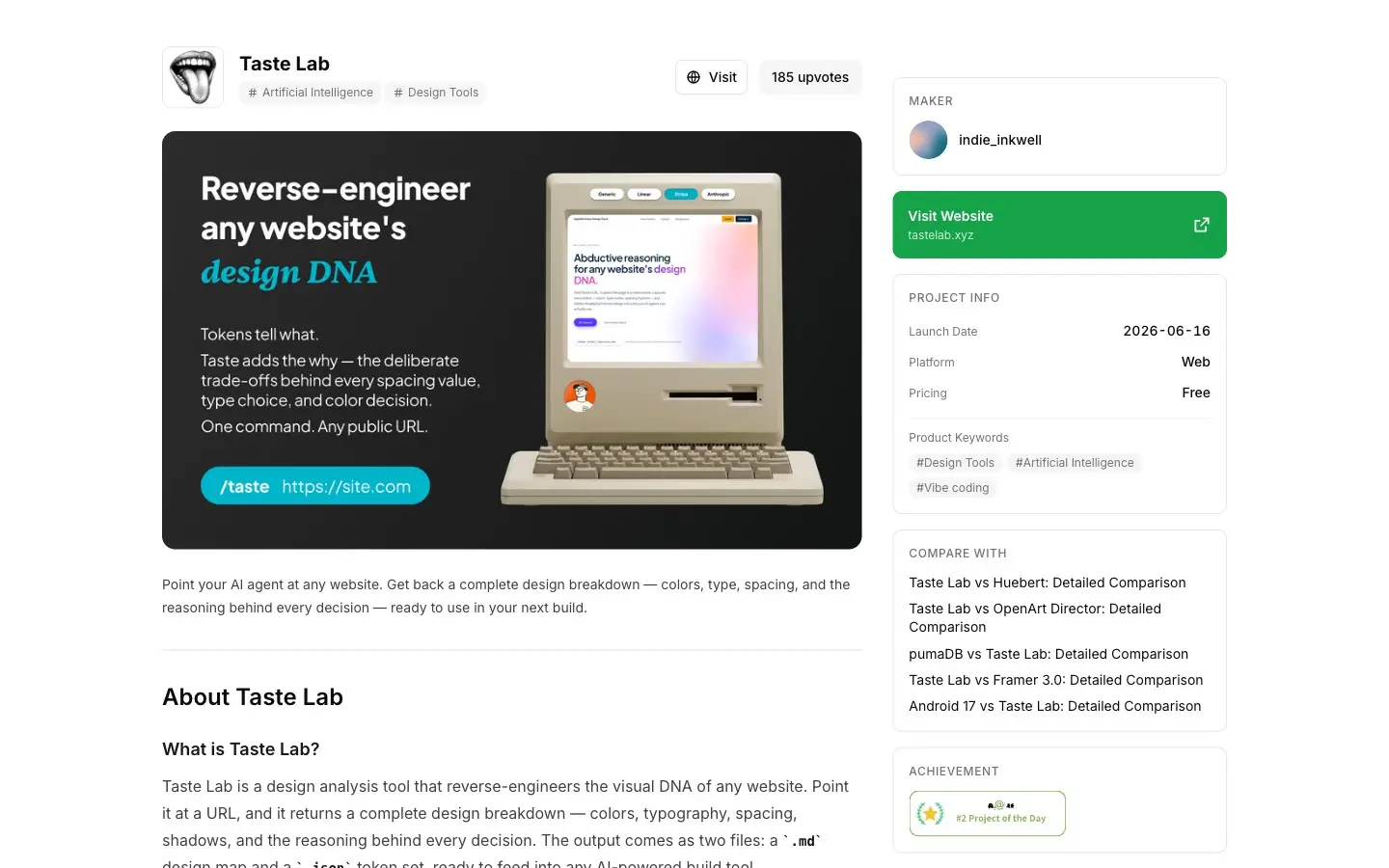
Taste Lab is a cutting-edge design analysis tool built for design engineers, product teams, and AI agent builders looking to reverse-engineer the visual architecture of any web experience. Rather than stopping at basic color picker extractions, the platform runs a sequential four-agent extraction pipeline to discover raw parameters, deduce core token rules, infer the designer's foundational trade-offs, and package the entire visual ethos into reusable Markdown design maps and system JSON token files.
Taste Lab was built in 2026 to solve a constant, recurring roadblock within automated development workflows: pointing advanced LLMs at benchmark design websites only to receive generic, misaligned style templates in return. Recognizing the constraint was a lack of structured contextual language, the founders engineered a framework that transforms visual aesthetics into precise token configurations.