Loading SaaS profile...
Loading SaaS profile...
Managed infrastructure for training and fine-tuning custom AI models.
Manages distributed training and fine-tuning experiments across high-performance GPU clusters via a simple Python SDK. Automates infrastructure complexity, including resource scheduling, model synchronization, and training recovery, to maximize GPU utilization. Provides a modular toolkit (Tinker Cookbook) with recipes for supervised fine-tuning (SFT), reinforcement learning (RLHF), and preference learning (DPO). Supports popular open-source architectures like Llama and Qwen, allowing users to fine-tune models on proprietary datasets with full algorithm control. Enables rapid iteration and reproducible research by minimizing manual infrastructure setup and optimizing compute efficiency for large-scale model adaptation.
Infrastructure abstraction allows developers to focus on data and training logic rather than low-level cluster management or GPU orchestration. Managed distributed training significantly reduces training time and compute waste, leading to faster iteration cycles for complex model fine-tuning. Open-weights compatibility allows users to own and control their customized models, avoiding vendor lock-in typical of proprietary closed-source AI labs. Built-in cookbook recipes provide ready-to-use implementations for advanced techniques like RLHF and DPO, lowering the barrier to entry for complex training workflows. Optimized scheduling ensures hardware remains active rather than idle, resulting in lower energy usage and reduced costs for high-compute experimentation.
Category: AI & Automation
Team Size: 100+
Visit Website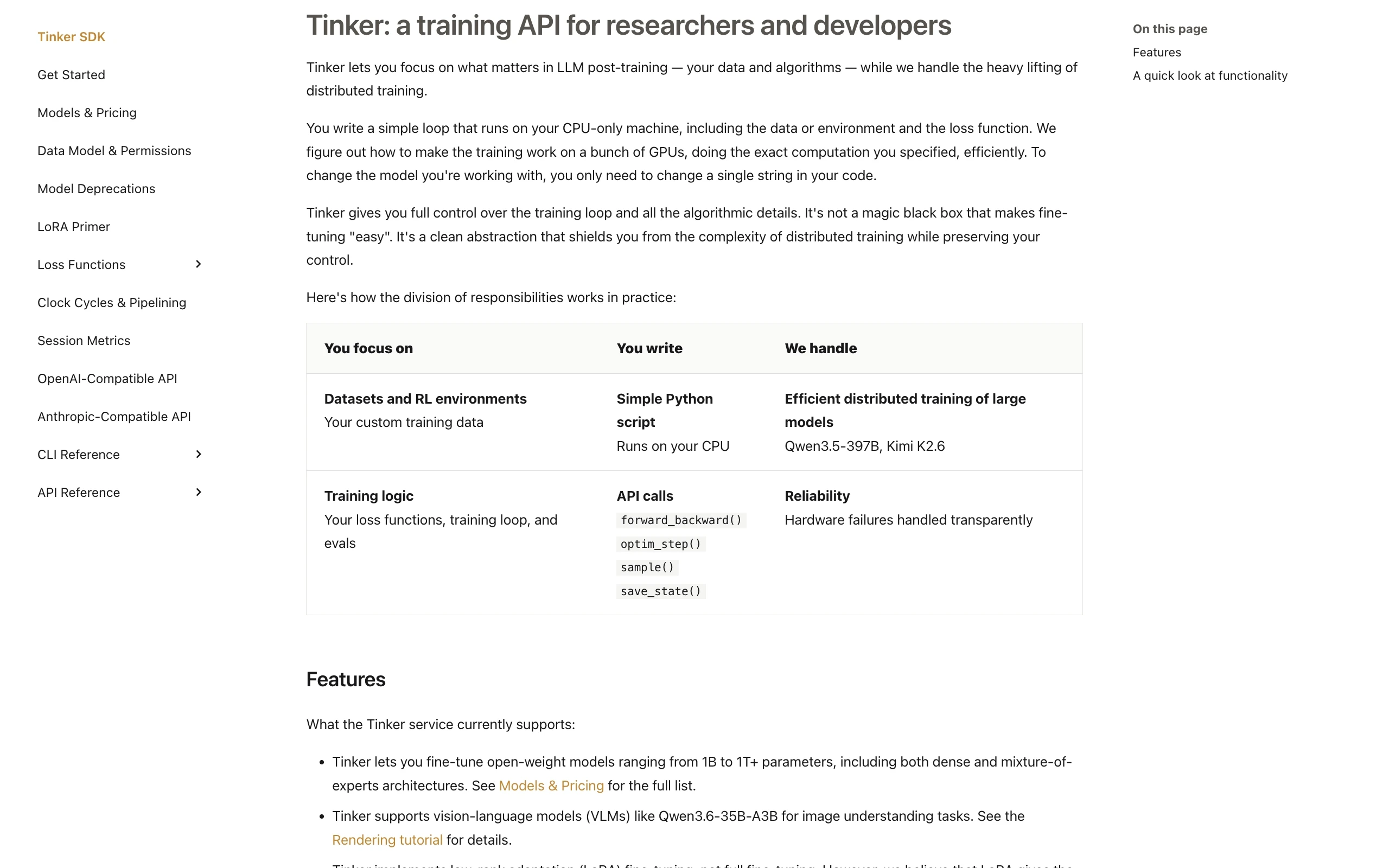
Tinker is a cloud-based developer platform by Thinking Machines Lab that simplifies the training and adaptation of large AI models. It acts as an infrastructure layer between developers and raw GPUs, handling distributed training complexities like scheduling, synchronization, and recovery. By abstracting low-level systems, Tinker allows researchers and developers to customize open-weights models efficiently without needing to manage supercomputing clusters.
Tinker was developed by Thinking Machines Lab, a San Francisco-based AI startup founded in February 2025 by Mira Murati, the former CTO of OpenAI. The lab was created to decentralize AI development and provide developers with the tools to train and customize frontier-capable models without the heavy infrastructure burden typical of closed-source incumbents.