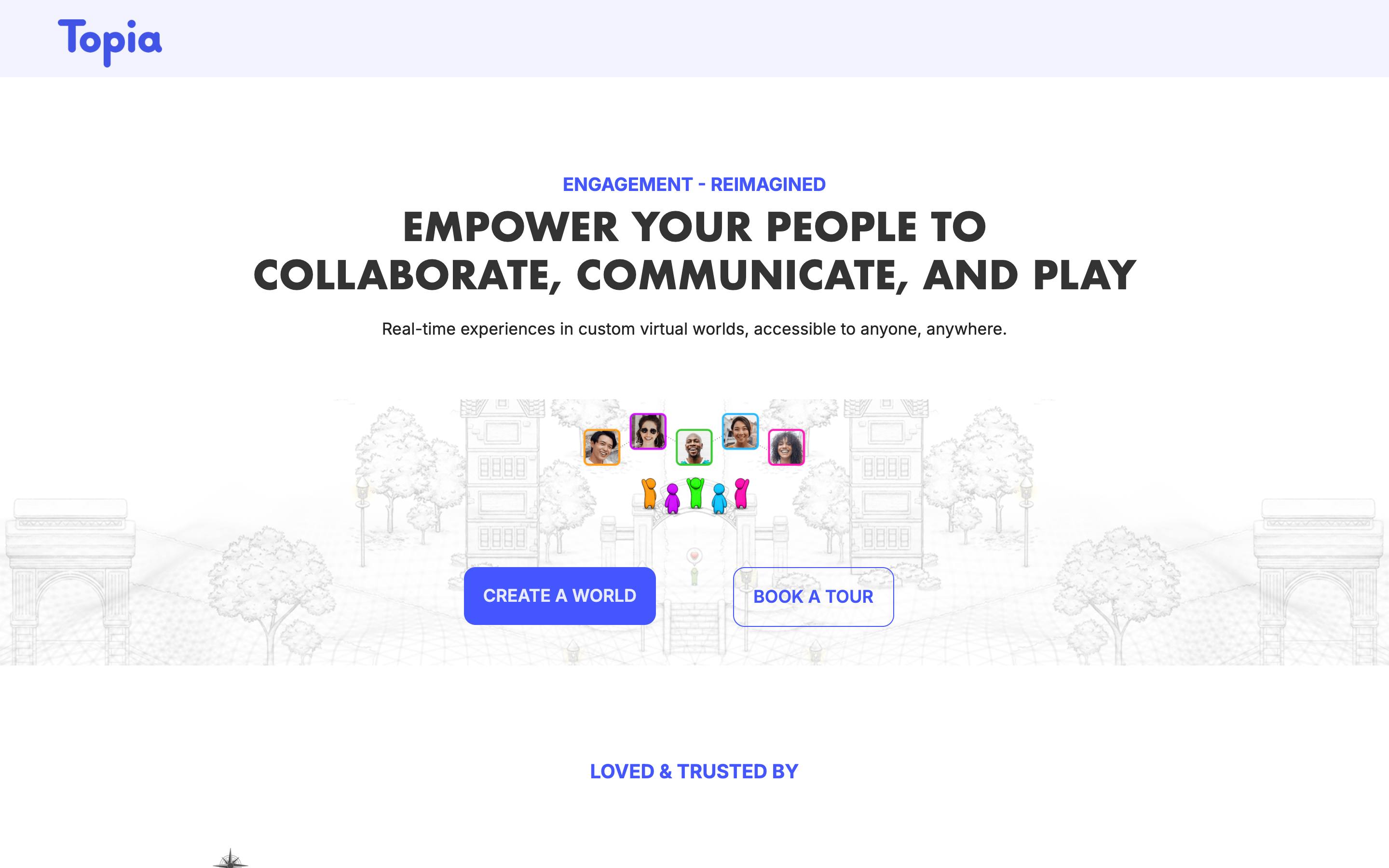
A customizable spatial communication platform for virtual worlds.
What it does
Creates persistent, 2D virtual worlds with proximity-based audio.
Allows for complete world customization with drag-and-drop assets.
Hosts virtual festivals, conferences, and remote offices.
Enables live streaming and embedded media within virtual spaces.
Requires no app downloads; runs entirely in a web browser.
Why it works
Organic Interaction: Proximity audio allows for multiple private conversations to happen in a single space simultaneously, just like in real life.
Creativity: The platform is highly visual and artistic, allowing for 'hand-drawn' aesthetics that feel more human than cold, corporate Zoom calls.
Accessibility: Because it's browser-based, there is virtually zero barrier to entry for attendees.
Persistent Presence: Worlds stay online indefinitely, allowing communities to have a 'digital home' they can return to anytime.
A customizable spatial communication platform for virtual worlds.
Overview
Topia is a spatial web platform that allows creators and organizations to build immersive, browser-based virtual worlds. Unlike standard video conferencing, Topia uses proximity-based audio, meaning you only hear the people your avatar is standing near, making digital social interactions feel as natural and organic as real-world festivals or offices.
Founded year:2020
Founder:Daniel Liebeskind
Team size:11-50
Popularity:Thousands of custom worlds built
HQ:Los Angeles, USA
Status:Active
Funding status:Funded
Funding:Seed
Pricing:Freemium
Tech stack:JavaScript, React, WebRTC
Platform:Web
Integrations:Stripe, Slack, YouTube, Twitch
What it does
Creates persistent, 2D virtual worlds with proximity-based audio.
Allows for complete world customization with drag-and-drop assets.
Hosts virtual festivals, conferences, and remote offices.
Enables live streaming and embedded media within virtual spaces.
Requires no app downloads; runs entirely in a web browser.
Who it's for
Event organizers
Community leaders
Remote companies
Educators
Why it works
Organic Interaction: Proximity audio allows for multiple private conversations to happen in a single space simultaneously, just like in real life.
Creativity: The platform is highly visual and artistic, allowing for 'hand-drawn' aesthetics that feel more human than cold, corporate Zoom calls.
Accessibility: Because it's browser-based, there is virtually zero barrier to entry for attendees.
Persistent Presence: Worlds stay online indefinitely, allowing communities to have a 'digital home' they can return to anytime.
Founder story
Founded in 2020 by Daniel Liebeskind. Daniel wanted to find a way to make digital interactions feel more like the serendipitous encounters he experienced at festivals and conferences. He built Topia to prove that virtual spaces didn't have to be clinical or game-like, but could be beautiful, artistic places for human connection.

Alternatives
Comparison overview
Gather.town: Uses a pixel-art, game-like aesthetic, whereas Topia leans toward a more artistic, hand-drawn look.
Kumospace: Focuses heavily on the 'virtual office' market with professional aesthetics, while Topia is more creative and community-focused.
Spatial.chat: A strong competitor in the events space with a focus on simplicity, but lacks Topia's deep world-building tools.
Topia is the choice for creators who want their virtual space to be a work of art rather than a video game.