
Loading SaaS profile...
Loading SaaS profile...
A unified AI-powered operating system that integrates email, tasks, docs, CRM, and communication into one interconnected workspace.
Unified Inbox: Centralizes emails, channel messages, task assignments, and agent responses with signal-vs-noise filtering Collaborative Docs: Real-time, markdown-native documents built on CRDTs with bidirectional @linking Integrated Tasks: Linear-inspired task management deeply woven into email and communication channels AI Agents: Autonomous agents with access to team-level memory that can take actions across all connected apps Canvas: A 2D interactive space for organizing embedded links to tasks, files, and emails CRM & Calls: Native CRM functionality with recorded and transcribed video calls logged to team memory
Bidirectional @linking creates a searchable web of context that eliminates document silos Channel-based permissions automatically manage access rights based on team membership Unified memory allows AI agents to act with full context of past decisions, emails, and meetings Keyboard-first design and Rust/SolidJS stack ensure high performance and speed Single-system approach removes the friction of switching between disparate apps for cross-functional workflows
Category: Productivity
Team Size: 11-50
Visit Website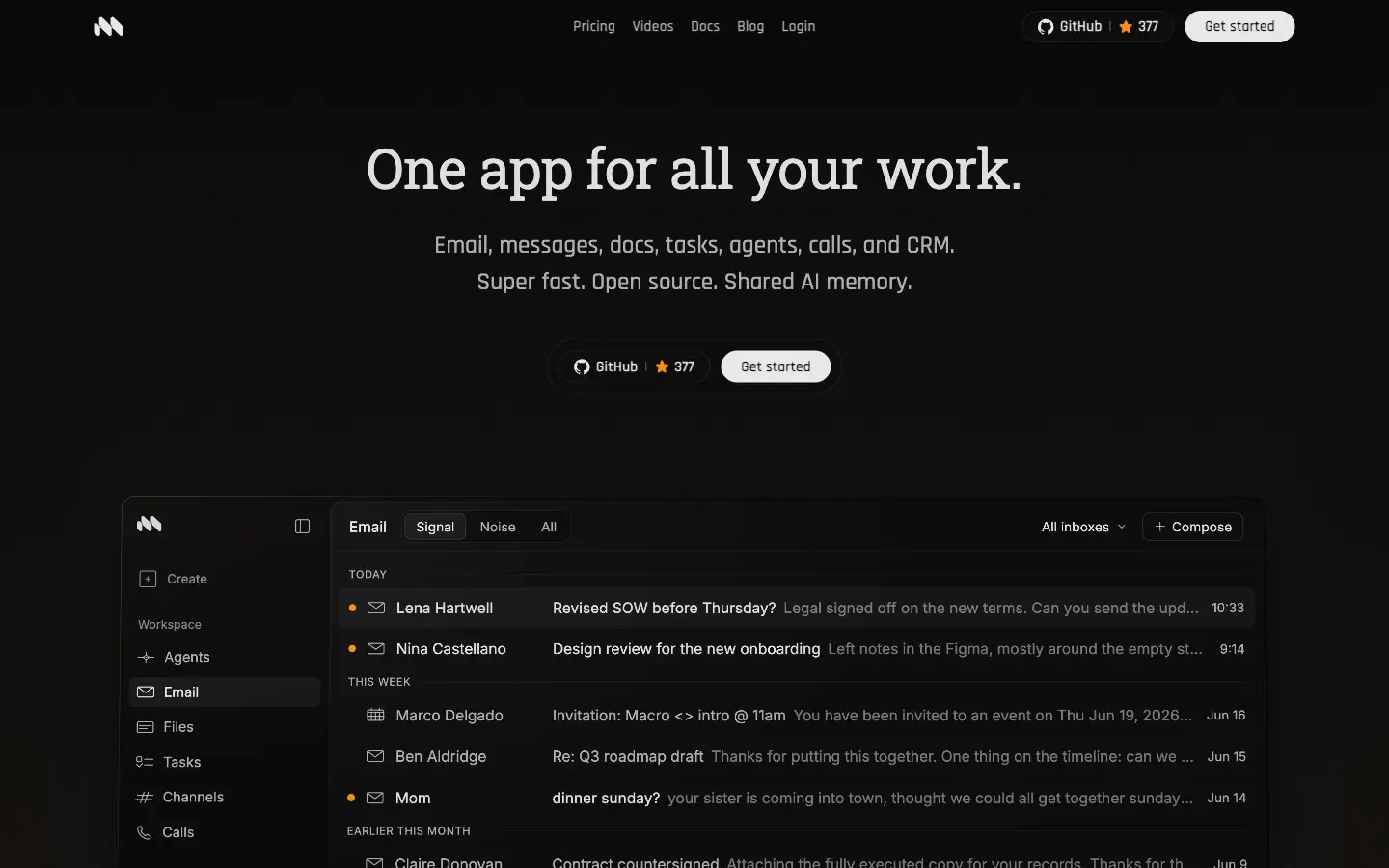
Macro is an ambitious, open-source unified interface that replaces siloed tools like Slack, Linear, Notion, and HubSpot by connecting them into a single system with shared team-level AI memory. Built from first principles using Rust and SolidJS, it creates a 'web of context' where every document, task, email, and message is bidirectionally linked, allowing AI agents to understand and act on a team's entire operational history.
Macro was founded in 2021 by Jacob Beckerman, a former student of the Jerome Fisher M&T Program at UPenn/Wharton and analyst at Bridgewater Associates. Frustrated by the lack of interoperability between modern SaaS tools, Beckerman aimed to rebuild the office suite from first principles, launching Macro as a unified OS for startups to centralize their knowledge and operations.